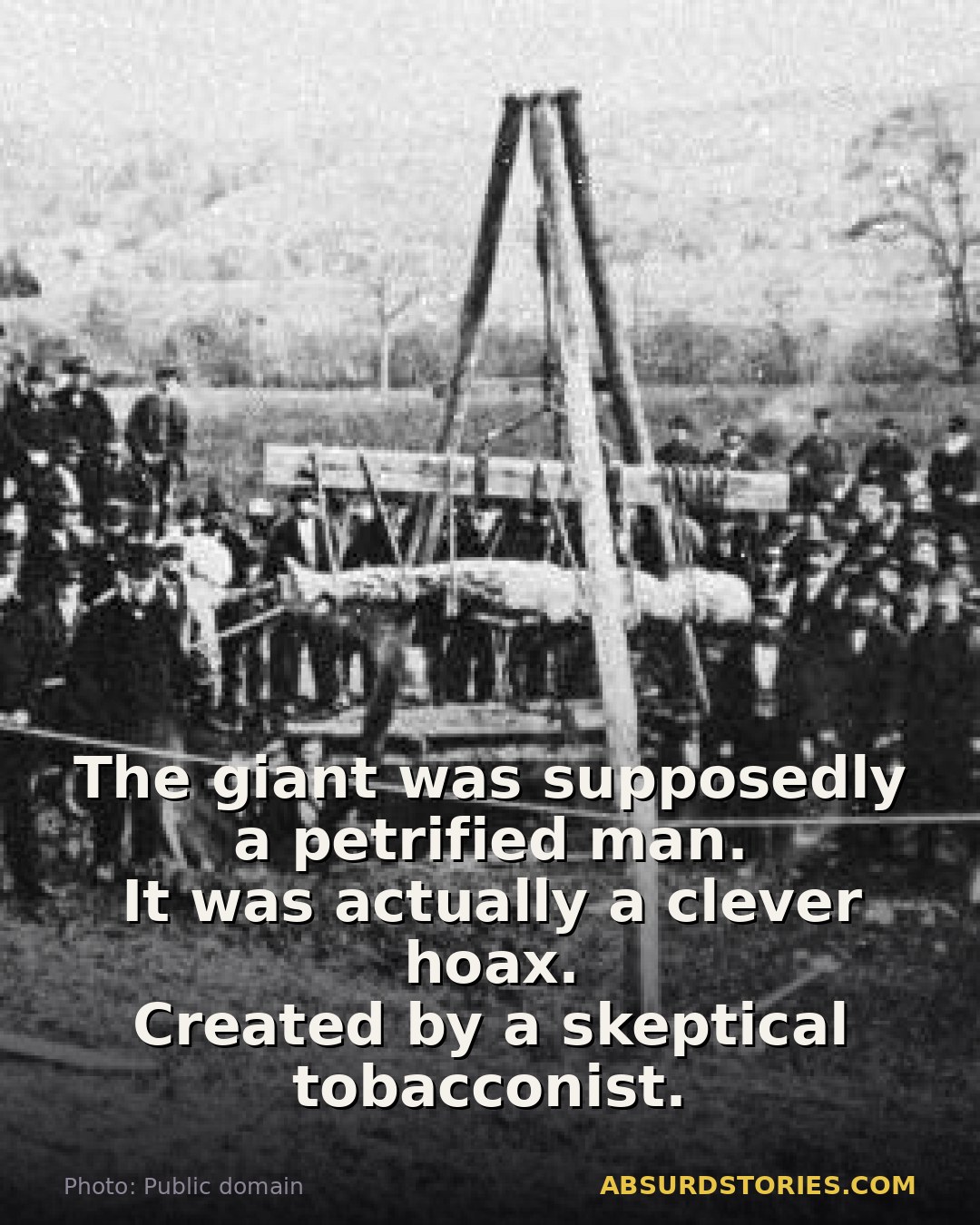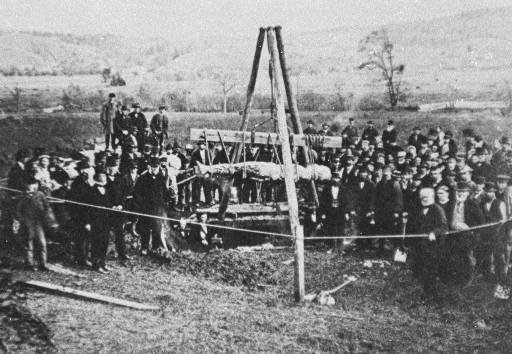
In 1869, a well-digging team in Cardiff, New York, unearthed a supposed 10-foot-tall petrified man. This bizarre discovery attracted crowds who flocked to see the giant. Unbeknownst to them, it was a masterful hoax.
The Cardiff Giant was fabricated by George Hull, a New York tobacconist. Hull’s fascination with scientific theories, particularly evolution, led him to concoct a plan after losing a debate about biblical giants. He wanted to showcase how easily gullible people could be.
Hull wasn't the first to suggest that petrified humans existed. Earlier reports in newspapers hinted at such wonders, which inspired him to create his own giant. In 1868, Hull and an accomplice commissioned sculptors to carve a block of gypsum into the shape of a man, spending significant amounts of money in the process.
The giant was designed to resemble Hull himself, right down to the absence of hair, as he learned that hair could not petrify. Once carved, the giant underwent a transformation to appear ancient, with various stains and techniques applied to its surface.
After its creation, Hull buried the giant on his cousin's farm. Nearly a year later, when it was “discovered,” the excitement was palpable. Visitors initially viewed the giant for free, but soon a tent was erected to charge admission, drawing hundreds of eager spectators each day.
Despite the crowd’s enthusiasm, skepticism emerged quickly. Some claimed the giant was merely a statue, while experts like John F. Boynton and Othniel C. Marsh pointed out clear signs of forgery. Barnum himself capitalized on the frenzy by creating a replica, effectively claiming it was the authentic giant.
While many were captivated by this spectacle, the layers of deception were eventually peeled back, revealing the Cardiff Giant for what it truly was: an elaborate prank that temporarily captivated a nation.