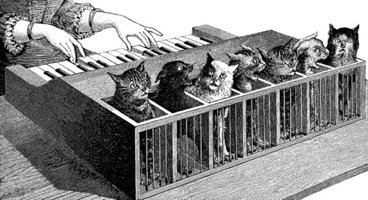
Picture this: a collection of cats arranged in a bizarre setup, with their tails pinned beneath a keyboard. When a key is pressed, a cat lets out a meow, contributing to a strange symphony. This peculiar instrument is known as a cat organ, or Katzenorgel in German, and it has never actually been constructed.
The idea first appeared in literature, with notable mentions dating back several centuries. One of the earliest accounts surfaces in the writings of Jean-Baptiste Weckerlin from the late 19th century. He described a fantastical procession that included a bear playing an organ made of cats. As the bear operated the instrument, each cat would cry out in a lamentable chorus, creating a cacophony of meows.
The concept continued to captivate imaginations, with mentions by other prominent figures like Johann Christian Reil, who believed that the instrument could cure attention disorders. He thought the spectacle of cats meowing would draw the attention of patients.
Athanasius Kircher also described the cat organ in his 17th-century work. He suggested that it was designed to alleviate the melancholy of a prince, using the varying pitches of the cats’ cries to achieve a form of musical expression. Each cat was positioned according to its natural tone, ready to respond to the musician's whims.
Despite its bizarre allure, the cat organ remained a theoretical construct. Though it never found its way to reality, the notion has been referenced in various modern works. From short stories to animations, the idea of a cat piano continues to inspire creativity and humor.
While no one has ever created a working cat organ, its absurdity lives on. The thought of such an instrument brings a whimsical touch to the legacy of musical invention.